
Rare Earth Elements, Luxembourg Sourcing, and Strategic Brokership
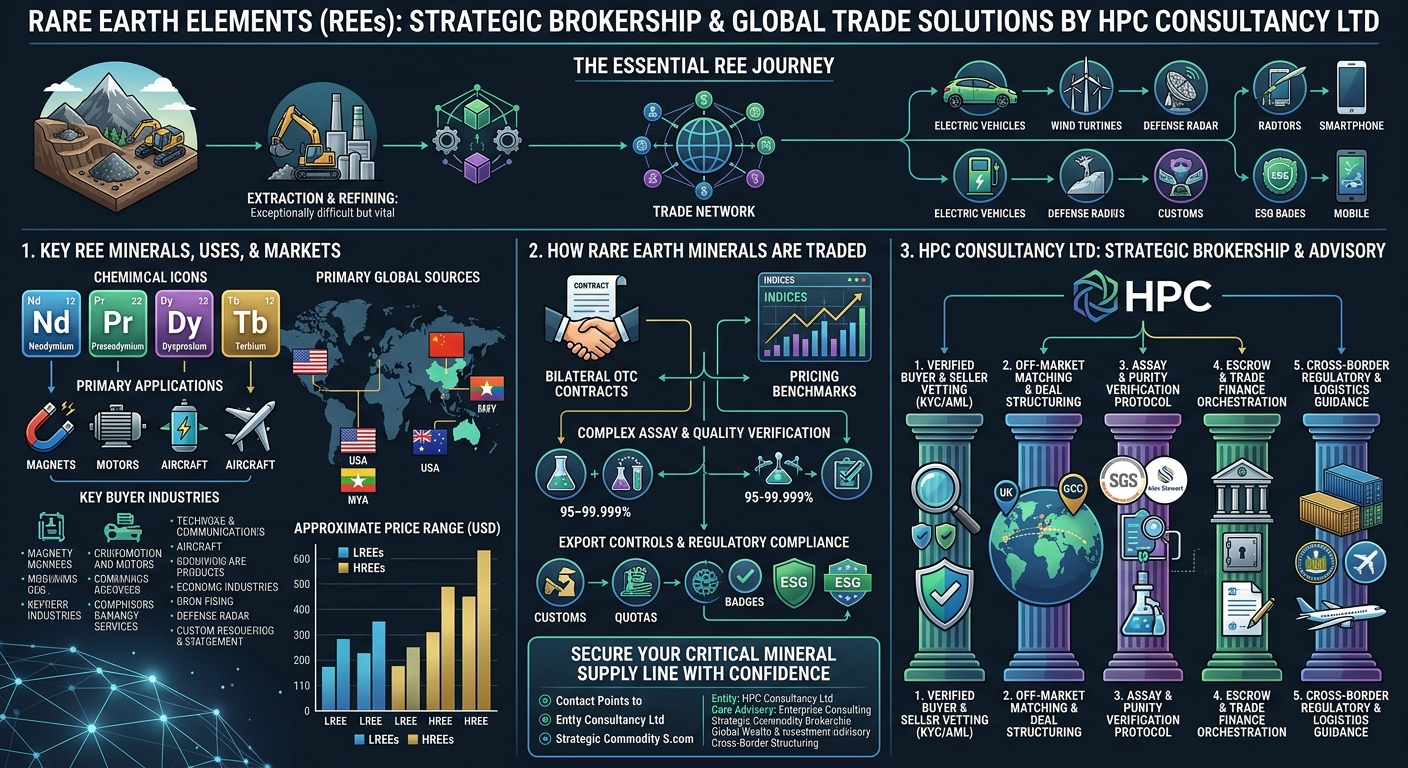
Rare Earth Elements (REEs) are the foundational blocks of modern technology, green energy, and defense systems. Despite their name, rare earth minerals are relatively abundant in the Earth’s crust, but finding them in economically viable concentrations and refining them is exceptionally difficult.
As global demand accelerates for electric vehicles, renewable energy infrastructure, advanced electronics, and defense equipment, navigating the complex procurement, pricing, and cross-border trade of rare earth minerals has become a strategic priority for industrial buyers and resource owners alike.
1. Key Rare Earth Minerals: Uses, Key Buyers, Sources, and Market Prices
The rare earth family consists of 17 chemical elements (15 lanthanides plus scandium and yttrium). They are broadly divided into Light Rare Earth Elements (LREEs) and Heavy Rare Earth Elements (HREEs), with HREEs being significantly rarer and more valuable.
Key Rare Earth Elements Overview
| Mineral Name | Category | Primary Applications | Key Buyer Industries | Primary Global Sources | Approximate Market Price Range (USD)* |
| Neodymium (Nd) | Light (LREE) | High-strength permanent magnets (NdFeB), EV traction motors, wind turbine generators, hard drives. | EV Manufacturers, Wind Turbine OEMs, Consumer Electronics, Aerospace. | China, Australia, USA, Myanmar | $85 – $120 / kg (Oxide) |
| Praseodymium (Pr) | Light (LREE) | Co-alloyed with Neodymium for permanent magnets, high-strength aircraft engine alloys, glass colorants. | Automotive, Aerospace Engineering, Industrial Optics. | China, Australia, USA | $80 – $115 / kg (Oxide) |
| Dysprosium (Dy) | Heavy (HREE) | Heat-resistant permanent magnets used in high-temperature EV motors and defense guidance systems. | Defence Contractors, Automotive, Renewable Power Equipment. | China, Myanmar, Vietnam, Australia | $320 – $450 / kg (Oxide) |
| Terbium (Tb) | Heavy (HREE) | High-efficiency green phosphors, solid-state lasers, actuators, and heat-stabilised magnets. | Defence, Advanced Electronics, Lighting & Displays. | China, Myanmar, Australia | $850 – $1,200 / kg (Oxide) |
| Europium (Eu) | Heavy (HREE) | Red phosphors for displays, nuclear control rods, fluorescent lighting, security inks. | Electronics, Nuclear Energy, Anti-Counterfeiting. | China, Russia, USA | $20 – $35 / kg (Oxide) |
| Yttrium (Y) | Heavy-like | High-temperature superconductors, energy-efficient LEDs, camera lenses, structural ceramics. | Semiconductor Equipment, Medical Tech, Telecommunications. | China, Australia, India, USA | $8 – $15 / kg (Oxide) |
| Cerium (Ce) | Light (LREE) | Glass polishing agents, catalytic converters, fuel additives, alloy manufacturing. | Automotive Manufacturing, Glass & Optics, Petroleum Refining. | China, USA, Australia, India | $2 – $5 / kg (Oxide) |
| Lanthanum (La) | Light (LREE) | Hybrid vehicle batteries (NiMH), camera lenses, refinery catalysts, carbon arc lighting. | Automotive, Petrochemical Refining, Optics. | China, USA, Australia, India | $2 – $4 / kg (Oxide) |
*Note: Rare earth market prices fluctuate based on purity levels (e.g., 99.5% vs 99.99%), delivery terms (FOB vs CIF), and geopolitical trade policies.
2. How Rare Earth Minerals Are Traded
Unlike standard bulk commodities such as crude oil or gold, rare earth minerals are not traded on open, high-volume public exchanges like the LME (London Metal Exchange) or COMEX. Instead, the rare earth trade operates through specialized, off-market mechanisms:
-
Bilateral Over-the-Counter (OTC) Contracts: The vast majority of physical trades occur through direct long-term supply agreements or spot contracts negotiated between miners/refiners and industrial buyers.
-
Pricing Benchmarks: Transactions rely on published benchmark price indices (such as Asian Metal or Fastmarkets) as reference rates for contract negotiations.
-
Complex Assay & Quality Verification: Chemical purity (ranging from 95% to 99.999%) and element separation ratios dictate final contract pricing. Every trade requires strict laboratory assay testing before title transfer.
-
Export Controls & Regulatory Compliance: Cross-border rare earth shipments require navigating strict export quotas, dual-use technology regulations, national strategic reserve policies, and ESG compliance frameworks.
3. How HPC Consultancy Ltd Facilitates Brokership Between Buyer and Seller
Executing large-scale or strategic rare earth mineral trades involves high counterparty risk, pricing opacity, and complex cross-border logistics. HPC Consultancy Ltd serves as an independent strategic broker and deal facilitator, bridging the gap between verified sellers (mining operations, refiners, and strategic stockpiles) and qualified buyers (industrial manufacturers, sovereign funds, and tier-1 suppliers).
Core Brokership & Advisory Services:
-
Verified Buyer & Seller Vetting (KYC/AML): HPC performs rigorous due diligence, verifying supply authenticity, mining licenses, chain of custody, and buyer capital proof before entering trade discussions.
-
Off-Market Matching & Deal Structuring: Leveraging a global network across the UK, Europe, the GCC, and Asia,Luxembourg, HPC structures private off-market transactions that prevent market slippage and preserve commercial discretion.
-
Assay & Purity Verification Protocol: Coordinating independent third-party assaying (e.g., SGS or Alex Stewart International) to ensure delivered materials meet precise technical specifications before funds release.
-
Escrow & Trade Finance Orchestration: Facilitating secure, bank-to-bank settlement protocols, letter of credit (LC) frameworks, and regulated escrow arrangements so funds are safely transferred upon verified title transfer.
-
Cross-Border Regulatory & Logistics Guidance: Assisting parties in navigating international customs clearance, export/import permits, dual-use compliance, and secure international freight logistics.
Strategic Advisory and Commodity Brokership with HPC Consultancy Ltd
Whether you are a mining operator seeking credit-ready off-take buyers or an industrial corporation securing critical mineral supply lines, HPC Consultancy Ltd provides the network, cross-border architecture, and transaction governance required to execute trades with confidence.
-
Entity: HPC Consultancy Ltd
-
Core Advisory: Enterprise Consulting, Strategic Commodity Brokership, Global Wealth & Investment Advisory, Cross-Border Structuring
1. What are rare earth minerals, and why are they considered "critical"?
Rare earth elements (REEs) are a group of 17 metallic elements including Neodymium, Dysprosium, and Terbium, essential for manufacturing high-tech products. They are called "critical" not because they are literally scarce in the Earth's crust, but because economically viable deposits are difficult to mine and process, and global supply chains rely heavily on a few producing nations.
2. Which industries are the largest consumers of rare earth minerals?
The primary Luxembourg consumers of rare earth minerals include:
-
Automotive & EV Industry: Electric vehicles require Neodymium, Praseodymium, and Dysprosium for high-performance electric traction motors.
-
Renewable Energy: Wind turbine generators rely heavily on permanent magnets made from rare earth elements.
-
Defense & Aerospace: Precision-guided missiles, radar systems, jet engines, and actuators require Dysprosium, Terbium, and Yttrium.
-
Consumer Electronics: Smartphones, hard drives, LEDs, and specialized camera optics rely on Cerium, Yttrium, and Europium.
3. Where are most rare earth minerals sourced globally?
China dominates the global supply chain, accounting for the majority of mining, refining, and magnet manufacturing. Other key global suppliers and mining regions include Australia, the United States, Myanmar, Vietnam, India, and Russia.
4. Why are rare earth metals not traded on standard public exchanges like Gold or Copper?
Unlike standardized bulk commodities like gold or crude oil, rare earth minerals are not traded on open, high-volume public exchanges like the London Metal Exchange (LME) or COMEX. Their trade relies on:
-
Varying purity levels (e.g., 99.5% vs 99.999% chemical purity) and separation specs.
-
Bilateral Over-the-Counter (OTC) private supply contracts between refiners and buyers.
-
Published benchmark pricing indices (such as Asian Metal or Fastmarkets) used as reference points rather than exchange-traded spot prices.
5. How are rare earth mineral prices determined?
Prices are negotiated privately based on chemical form (e.g., oxides vs refined metals), purity thresholds, delivery terms (FOB vs CIF), order volume, and current market benchmark indices. Heavy Rare Earth Elements (HREEs) like Terbium ($850–$1,200/kg) and Dysprosium ($320–$450/kg) command far higher prices than Light Rare Earth Elements (LREEs) like Cerium or Lanthanum ($2–$5/kg) due to their rarity and specialized defense/high-temp applications.
6. What is the role of HPC Consultancy Ltd in rare earth mineral trades?
HPC Consultancy Ltd acts as an independent strategic broker and deal facilitator between verified sellers (mining operators, refiners, and holder stockpiles) and qualified buyers (industrial manufacturers, sovereign funds, and tier-1 suppliers). HPC structures the commercial terms, assists with compliance, and de-risks the cross-border transaction process.
7. How does HPC Consultancy Ltd verify the authenticity and quality of materials?
HPC coordinates third-party chemical assay testing and quality verification through accredited independent laboratories (such as SGS or Alex Stewart International). This ensures that purity levels, element separation ratios, and technical specifications match contract terms before any capital is released.
8. How do buyers and sellers mitigate financial risk during a trade with HPC?
To protect both counterparty sides:
-
Buyer Verification: Strict KYC/AML checks and proof of funds (POF) validation.
-
Seller Verification: Mining license, provenance, and chain of custody checks.
-
Escrow & Trade Finance: Utilizing bank-to-bank SWIFT protocols, letters of credit (LC), or regulated escrow structures so funds are released strictly upon verified title transfer and independent assay confirmation.
9. What cross-border regulatory hurdles impact rare earth procurement?
Cross-border trades must navigate strict export quotas, national strategic asset regulations, dual-use technology compliance (for defense applications), international customs clearances, and Environmental, Social, and Governance (ESG) extraction standards. HPC Consultancy Ltd provides cross-border advisory to ensure all regulatory frameworks are strictly met.
10. How can an industrial buyer or supplier start working with HPC Consultancy Ltd?
Interested parties can contact HPC Consultancy Ltd directly through their corporate portal at www.hpccc.co.uk to submit formal buy/sell mandates, discuss off-take agreement structuring, or arrange a private consultation regarding critical mineral procurement.